Power Flushing in Bournemouth, Poole & Dorset
Power Flushing — Fixed Price
From £299 + VAT
Inhibitor included · Fixed quote before we start
Gas Safe registered no. 943146 · 190+ reviews · Local engineers based in Poole
Cold patches on your radiators, a boiler that bangs or gurgles, heating that takes an age to warm up — nine times out of ten, that’s sludge. Our power flushing service clears it out of the radiators, pipework and boiler, across Bournemouth, Poole and the rest of Dorset. As a result, the heat gets where it should and the boiler stops working twice as hard to get it there.
Signs Your System Needs a Power Flush
Sludge builds up slowly, so the signs creep up on you. If you recognise any of these, it’s worth getting the system checked.
Radiators cold at the bottom
Warm at the top and cold at the bottom means sludge has settled and is blocking the flow. Unfortunately, bleeding won’t fix it. And if a radiator won’t heat at all, it’s often fully blocked.
Banging, kettling or gurgling from the boiler
Sludge and scale around the heat exchanger make water boil in hot spots — it sounds like a kettle. That puts the heat exchanger under strain. A failed heat exchanger is one of the dearest repairs a boiler can need, so it’s often the point where replacing the boiler makes more sense.
Heating slow to warm up
Less flow means the boiler runs longer to reach temperature. For example, if the house used to heat in 20 minutes and now takes 45, contamination is a likely cause — and you’re paying for the extra running time.
Black water when you bleed a radiator
Clear or slightly discoloured is normal. However, black or dark brown is magnetite — iron oxide sludge — and it means the system is heavily contaminated.
Lockouts, or pumps and valves keep failing
Sludge trips the boiler’s overheat protection and wears pumps and motorised valves like sandpaper. So if you’ve already replaced a pump and the problem has come back, the dirty system is the root cause — not the part.
How Our Power Flush Works
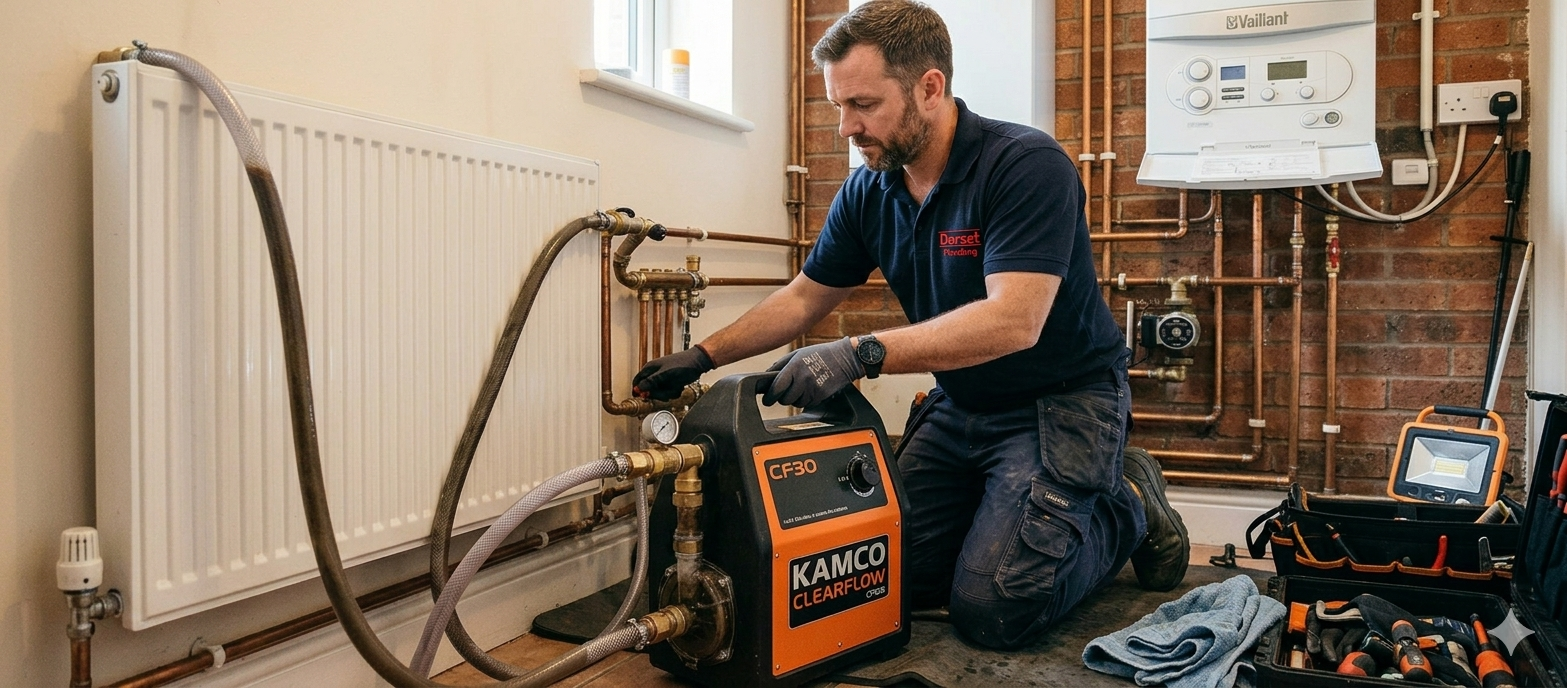
Over time, the water in your heating reacts with the steel inside radiators and creates iron oxide sludge. Once it’s compacted, draining and refilling won’t shift it. Instead, a power flush pumps cleaning chemical through the system at high flow and low pressure, which breaks the deposits up and carries them out.
1. Check the system first
First, we test radiator temperatures and system water, and look over the boiler, pump and pipework. That tells us how bad the contamination is — and whether a power flush is the right call or a gentler chemical clean is safer.
2. Flush every radiator
Our Kamco machine connects to the system and circulates cleaning chemical through the whole circuit. Then we isolate each radiator and flush it on its own until the water runs clear. This is where the time goes, and it’s what separates a proper flush from a quick rinse.
3. Refill and protect
After that, we take the dirty water away and refill the system with fresh water. Finally, we add a full dose of Fernox or Sentinel inhibitor, which slows sludge and scale from forming again.
4. Check it’s working
Before we leave, we check every radiator heats evenly and look over any joints the flush disturbed. You also get a record of the work with the inhibitor level noted.
What to Expect on the Day
Most flushes take 4 to 8 hours, depending on how many radiators you have and how dirty the system is. During that time, your heating and hot water will be off.
It helps if you can clear a little space around each radiator and near the boiler. On our side, we put down dust sheets, sit the machine on protective matting and take all the dirty water away — nothing goes down your sink.
Someone needs to let us in and be there when we finish. For landlords, we can arrange access directly with your tenant.
Power Flushing Prices — Poole & Bournemouth
From £299 + VAT
The price depends mainly on the number of radiators, plus how contaminated the system is. So tell us how many radiators you have when you call, and we’ll give you a fixed price. We agree it before we start, and we never add anything on the day.
Included: system check, full flush of every radiator, removal of dirty water, Fernox or Sentinel inhibitor, and a written record of the work.
Optional: a magnetic filter fitted at the same visit — just ask and we’ll add it to the quote.
Get a Fixed Price — 01202 668822Power Flush or Chemical Clean?
For most systems, a power flush is the most thorough option, because the flow does what chemical alone can’t. Even so, it isn’t right for every house.
On older systems with corroded or microbore pipework, the extra flow can find joints that were already on their way out. The flush doesn’t cause the weakness, but it can bring a leak forward. In that case, we’ll recommend a chemical clean instead: slower and less thorough, but gentler.
Either way, we’ll tell you honestly which one your system needs — not just the dearer one.
Getting a New Boiler? Clean the System First
Fit a new boiler to a dirty system and the old sludge goes straight through its new heat exchanger. That’s why industry guidance (BS 7593) calls for cleaning the system and adding inhibitor when a new boiler goes in. Most manufacturers, including Worcester Bosch, Vaillant and Glow-worm, also make it a condition of their warranty.
Our boiler installations include a system clean as standard. Having your boiler fitted by someone else? We can still flush the system beforehand.
Keeping Your System Clean Afterwards
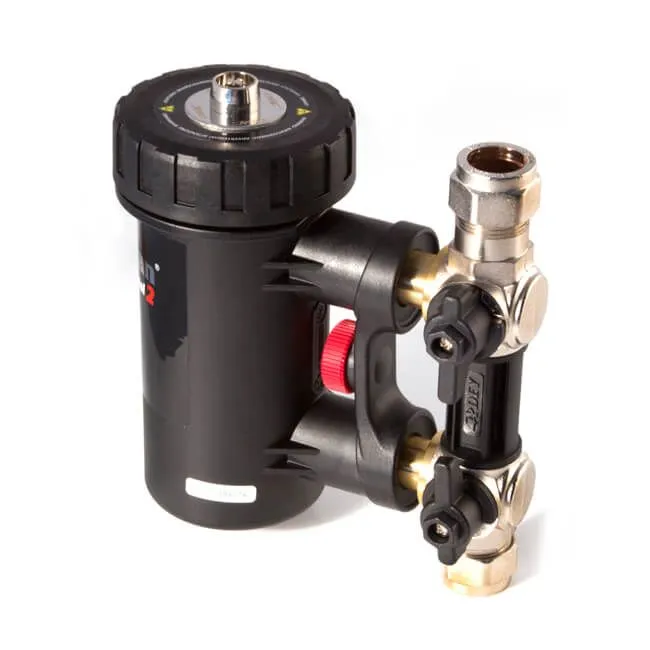
A flush clears what’s there now. To stop it coming back, you need three things.
A magnetic filter
A filter such as the MagnaClean sits on the return pipe near the boiler and catches iron oxide before it reaches the heat exchanger, pump or valves. Boiler manufacturers recommend one, and your engineer can clean it out in a few minutes at each service.
Inhibitor at the right level
Inhibitor coats the inside of the system and slows corrosion, but it weakens over time. For that reason, we test it every year and top it up when it drops.
An annual service
That’s when your engineer cleans the filter, checks the water and tops up the inhibitor — before contamination has a chance to build. See our boiler service page, or our boiler cover, which includes the service.
Look after it like this and a flushed system can stay clean for many years.
Why Dorset Plumbing?
- Gas Safe registered — no. 943146, so you can check us on the Gas Safe Register
- 190+ reviews from homeowners, landlords and letting agents across Bournemouth and Poole
- Honest advice — if a chemical clean suits your system better, we’ll say so
- Inhibitor included on every flush, never charged as an extra
- Fixed price agreed before we start, with nothing added on the day
- Local engineers in Poole, with no inflated travel charges
Areas We Cover
Bournemouth: Boscombe, Southbourne, Winton, Moordown, Charminster, Kinson, Westbourne, Talbot Woods, Pokesdown, Iford
Poole: Sandbanks, Parkstone, Lilliput, Whitecliff, Canford Heath, Broadstone, Hamworthy, Oakdale, Creekmoor, Branksome
Wider Dorset: Christchurch, Highcliffe, Ringwood, Ferndown, Wimborne, Verwood, West Moors, Wareham, Blandford Forum
Not listed? Call 01202 668822 — we probably cover you.
Power Flushing FAQs
How much does a power flush cost in Bournemouth and Poole?
From £299 + VAT. The price depends mainly on how many radiators you have, and we give you a fixed price before we start, with inhibitor included.
How long does a power flush take?
Usually 4 to 8 hours. We can do smaller systems in half a day, while larger or very dirty systems take a full day. Your heating and hot water will be off for most of it.
How often does a system need power flushing?
There’s no set interval. With a magnetic filter and the inhibitor kept topped up, a system can stay clean for many years. Instead, flush when the signs show up — cold spots, noise, black water — or when a new boiler goes in.
Can a power flush damage my pipework?
On a sound system, no, because it runs at high flow but low pressure. On older systems, however, it can show up joints that were already weak. That’s why we check first and recommend a chemical clean where that’s the safer option.
Do I need a power flush before a new boiler?
You need to clean the system before a new boiler goes in, since BS 7593 calls for it and most manufacturers make it a warranty condition. Depending on the system, that can be a power flush or a chemical clean. Our boiler installations include it as standard.
Do I need to be home?
Someone needs to let us in and be there when we finish. Landlords don’t need to attend, though — we can arrange access with the tenant.
Is inhibitor included?
Yes, always. Every flush finishes with a full dose of Fernox or Sentinel inhibitor, because without it corrosion starts again straight away.
Should I have a magnetic filter fitted?
If you don’t have one, yes. It catches sludge before it reaches the boiler, so it’s the best way to protect the system after a flush. We can also fit one at the same visit.